Carbon monoxide alarms around Deep Creek Lake: what Maryland law requires
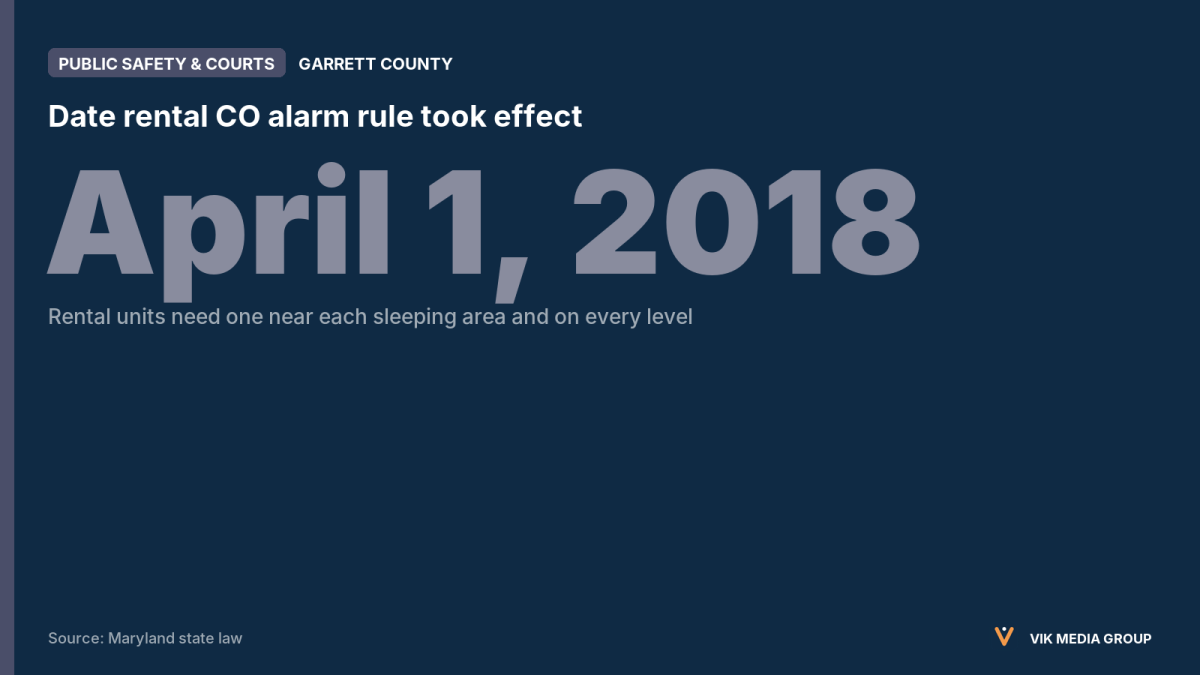
Maryland law requires carbon monoxide alarms in rental units, hotels and lodging houses, and in homes built with a permit issued on or after Jan. 1, 2008, that burn fossil fuel for heat, hot water, ventilation or a clothes dryer. Since April 1, 2018, rental units must have an alarm near each sleeping area and on every level, including the basement, under Maryland’s Public Safety Article. That covers much of the housing around Deep Creek Lake as furnaces, propane heaters and wood stoves start running for the winter.
Carbon monoxide is the reason. More than 200 people in the United States die every year from accidental carbon monoxide poisoning linked to consumer products, and more than 100 of those deaths involve portable generators, according to the U.S. Consumer Product Safety Commission.
Which homes in Garrett County need a carbon monoxide alarm?
Maryland’s carbon monoxide alarm law, Sections 12-1101 to 12-1104 of the Public Safety Article, applies to two groups as of Nov. 4, 2026:
| Type of building | Covered when | Where the alarm goes |
|---|---|---|
| Newly built dwelling | Building permit issued on or after Jan. 1, 2008, and it burns fossil fuel for heat, ventilation, hot water or a clothes dryer | A central location outside each sleeping area |
| Rental dwelling unit | Since April 1, 2018 | Outside and near each separate sleeping area, and on every level of the unit, including the basement |
| Hotel, lodging or rooming house | Since April 1, 2017 | In guest rooms and other rooms that contain a device that emits carbon monoxide, sit next to one, or connect to an enclosed attached garage |
A building with a central alarm system that can warn everyone inside may instead place alarms within 25 feet of each carbon monoxide-producing fixture, the law says.
The law’s scope does not list owner-occupied homes built before 2008, but the safety advice is the same for every house: the Consumer Product Safety Commission recommends carbon monoxide alarms on every level of the home and outside sleeping areas.
What kind of alarm does Maryland require?
Under the definitions in Section 12-1101, a carbon monoxide alarm must be wired into the home’s electrical line with a backup battery. In hotels, lodging houses and rental units, the alarm can instead be battery-powered if it is sealed, tamper-resistant and uses a battery that lasts at least 10 years. Alarms connected to a monitored control unit also qualify.
A combined smoke and carbon monoxide alarm is allowed if it meets the subtitle, Maryland’s smoke alarm law and the listed safety standards, UL 217 and 2034 or UL 268 and 2075, according to Section 12-1103.
What about vacation rentals at Deep Creek Lake?
Garrett County licenses short-term rentals as Transient Vacation Rental Units. The county’s licensing ordinance, in effect since March 1, 2006, requires working smoke alarms in each bedroom plus one more on each floor, and a wall-mounted fire extinguisher in the kitchen. The ordinance does not mention carbon monoxide alarms. Owners must get Garrett County Health Department approval every year showing compliance with “all codes, regulations and requirements.”
Before guests arrive this winter, owners can ask the Garrett County Health Department or the county’s licensing office whether their unit counts as a rental dwelling unit under the state carbon monoxide law, and put alarms near every bedroom and on every level either way.
How do I keep carbon monoxide out of the house during a winter storm?
The guidance below comes from the Consumer Product Safety Commission and from tips the Maryland Office of People’s Counsel published for winter weather.
- Put carbon monoxide alarms on every level and outside sleeping areas
- Check alarm batteries regularly
- Have the furnace and its vent checked
- Have the chimney or flue inspected before burning wood
- Run a generator outdoors only, at least 20 feet from the house, exhaust pointed away
- Never run a generator in the house or garage, even with doors open
When the power goes out after a heavy Garrett County snow, the generator is the biggest risk. A single portable generator can produce as much carbon monoxide as hundreds of cars, the commission says. Never run one inside a home or garage, even with the doors and windows open.
What are the signs of carbon monoxide poisoning?
Headache, dizziness, weakness, nausea, vomiting, sleepiness and confusion, according to the commission.
If an alarm sounds or anyone feels these symptoms, get everyone outside to fresh air immediately, then call 911.
Who can I ask about the law or my home?
- Emergencies: 911.
- Garrett County non-emergency, 24 hours: (301) 334-1929.
- Garrett County Department of Emergency Management: (301) 334-7619.
- Maryland law text: the Maryland General Assembly’s statute pages for Public Safety Sections 12-1101 to 12-1104.
This story explains Maryland law; it is not legal advice. Landlords and rental owners should confirm their obligations with the county or an attorney.
Tell us what you need to know about winter at home: email our newsroom through the Contact link at the bottom of this page.
More Home guides and local services ›
Live in the Deep Creek? Write for us as a Community Contributor and share what you see in your town.
Questions and answers
- Are carbon monoxide alarms required in Maryland rental homes?
- Yes. Since April 1, 2018, Maryland law requires carbon monoxide alarms in rental dwelling units outside and near each separate sleeping area and on every level, including the basement, under Public Safety Section 12-1104.
- Which Maryland homes need a carbon monoxide alarm?
- Homes built with a permit issued on or after Jan. 1, 2008, that burn fossil fuel for heat, ventilation, hot water or a clothes dryer, plus hotels, lodging houses and rental units, under Maryland's Public Safety Article.
- Does Garrett County require carbon monoxide detectors in vacation rentals?
- Garrett County's Transient Vacation Rental Unit ordinance requires smoke alarms in each bedroom and on each floor and a kitchen fire extinguisher, but it does not mention carbon monoxide alarms. Owners should check whether state law covers their unit.
- How far from the house should a generator be?
- At least 20 feet from the home, outdoors only, with the exhaust pointed away, according to the U.S. Consumer Product Safety Commission. Never run a generator in a home or garage.
- Can a Maryland carbon monoxide alarm run on batteries?
- In hotels, lodging houses and rental units, yes, if it is sealed, tamper-resistant and has a battery that lasts at least 10 years. Otherwise it must be hardwired with a battery backup.
Sources
- Maryland General Assembly: Public Safety Section 12-1101 (definitions)
- Maryland General Assembly: Public Safety Section 12-1102 (scope)
- Maryland General Assembly: Public Safety Section 12-1103 (combined alarms)
- Maryland General Assembly: Public Safety Section 12-1104 (installation)
- Garrett County: Transient Vacation Rental Unit Licensing Ordinance 2006-7
- U.S. Consumer Product Safety Commission: Carbon Monoxide Information Center
- Maryland Office of People's Counsel: winter weather