Mountain golf weather: lightning, fog and frost delays explained by NWS Pittsburgh
If someone on the course is struck by lightning, call 911 right away.
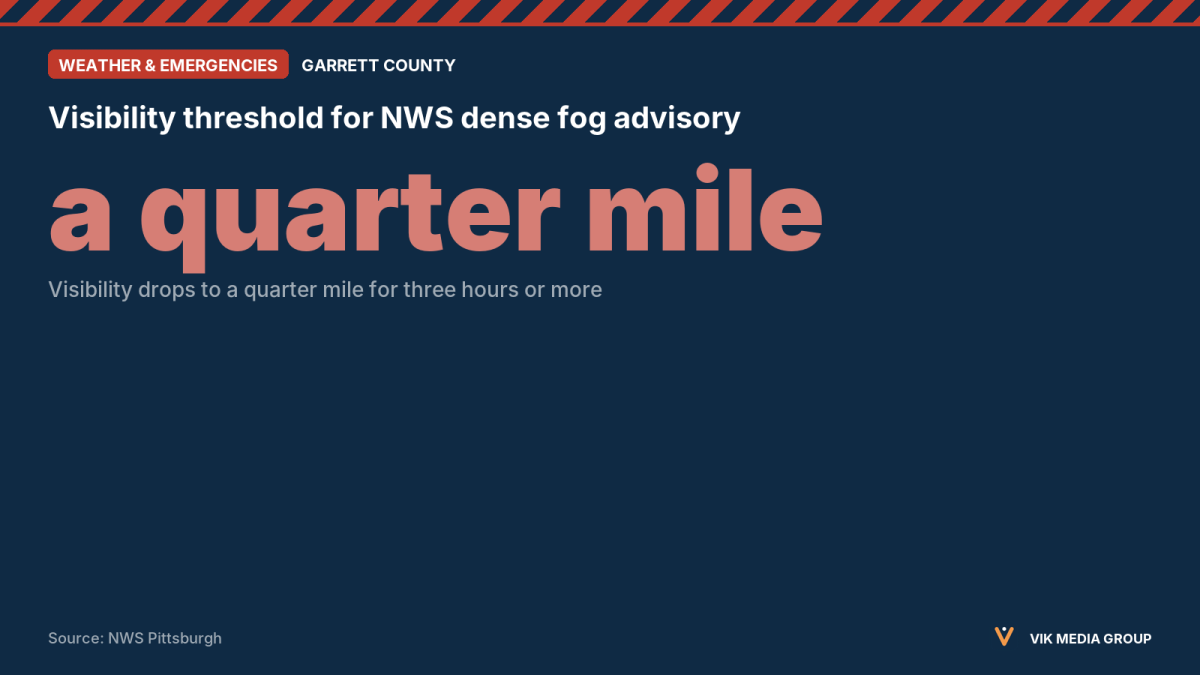
Three kinds of weather stop or delay golf in the mountains around Deep Creek Lake, and the National Weather Service office in Pittsburgh, which forecasts for Garrett County, has a rule for each. It issues a dense fog advisory when fog cuts visibility to a quarter mile or less for at least three hours, and a frost advisory when frost is expected during the growing season, according to NWS Pittsburgh’s alert criteria. For lightning, the rule is national: stop at the first thunder and wait 30 minutes after the last, per the NWS lightning safety guide.
Frost is the most common delay at the start and end of the season. At Oakland, May still averages 2.3 nights at or below freezing and October averages 9, according to NOAA’s 1991-2020 climate normals for the Oakland 1 SE station.
What alerts does NWS Pittsburgh issue that affect golf?
| Alert | NWS Pittsburgh criteria | What it means on the course |
|---|---|---|
| Dense fog advisory | Visibility of a quarter mile or less for at least 3 hours | Fairways and greens can disappear from the tee |
| Frost advisory | Frost expected during the growing season | Morning frost on greens; tee times are often pushed back |
| Freeze warning | 32 degrees or colder over a large area for a significant time, during the growing season | Hard frost; later starts likely |
| Severe thunderstorm warning | Winds of 58 mph or more, or hail 1 inch or larger | Leave the course and get indoors |
| Heat advisory | Heat index of 100 to 104 degrees | Rare at this elevation; drink water and slow down |
| Wind advisory | Sustained winds of 30 to 39 mph with gusts of 46 to 57 mph | Falling limbs; flags and carts affected |
Source: NWS Pittsburgh, watch, warning and advisory criteria, checked Oct. 30, 2026.
Frost and freeze alerts are issued only during the locally defined growing season, the stretch between the average last spring freeze and the average first fall freeze, according to the NWS office in Charleston, W.Va.. That office typically uses a frost advisory for forecast lows of 33 to 36 degrees and a freeze warning for 29 to 32. Once the first killing freeze of fall has happened, NWS Pittsburgh stops issuing freeze watches for the year.
Why do frost delays happen so often at Deep Creek Lake?
Because the mountain nights stay cold well into spring and return early in fall. At Oakland, according to NOAA’s 1991-2020 normals:
| Month | Avg. low (F) | Nights at or below freezing |
|---|---|---|
| April | 36.7 | 11.8 |
| May | 47.7 | 2.3 |
| June | 56.1 | 0.1 |
| September | 51.0 | 0.3 |
| October | 39.5 | 9.0 |
Walking or driving on frozen grass can damage greens, which is why courses hold the first tee times until the frost melts. From June through September, freezing nights are close to zero.
What should golfers do in dense fog?
The NWS advice for dense fog is to take extra care on the road or avoid driving, and it notes that freezing fog, which forms when temperatures are at or below freezing, coats roads and vehicles with ice, according to its fog safety page. On mountain roads to and from the course, fog is often the bigger danger than on the course itself. On the course, a ball hit into fog that hides the landing area can reach a group ahead that the golfer cannot see.
What should golfers do when they hear thunder?
- Stop play at the first sound of thunder. Lightning can strike up to 10 miles from the storm.
- Get inside a fully enclosed building, such as the clubhouse, or a hard-topped vehicle with the windows up.
- Stay away from open fairways, lone trees, ridgetops, towers and metal fences. Golf carts and open rain shelters give no protection.
- Wait 30 minutes after the last thunder before going back out.
From 2006 through 2019, lightning killed 418 people in the U.S.; 10 were golfing, and more than 70% of all deaths happened in June, July and August, according to an NWS analysis. Those are the heart of the Deep Creek golf season.
What should I do if someone is struck?
- Call 911.
- A person struck by lightning carries no electrical charge and is safe to touch.
- Start CPR if you are trained, and use an AED if the clubhouse has one.
This article explains federal safety guidance and is not medical advice.
Where do I check the forecast before a round?
- NWS Pittsburgh forecasts and alerts for Garrett County: weather.gov/pbz
- Emergencies: 911
When thunder roars, go indoors.
Played here this week? Tell us how the course was: email our newsroom through the Contact link at the bottom of this page.
More Health & Medical guides and local services ›
Live in the Deep Creek? Write for us as a Community Contributor and share what you see in your town.
Questions and answers
- Why are tee times delayed for frost at Deep Creek Lake?
- Walking or driving on frozen greens can damage them, so courses wait for frost to melt. At Oakland, April averages 11.8 freezing nights, May 2.3 and October 9, per NOAA 1991-2020 normals.
- When does NWS Pittsburgh issue a dense fog advisory?
- When fog is expected to cut visibility to a quarter mile or less for at least three hours, according to NWS Pittsburgh's alert criteria.
- Is a golf cart safe in a thunderstorm?
- No. The National Weather Service says open shelters give no protection; go into a building or a hard-topped vehicle and wait 30 minutes after the last thunder.
- Which National Weather Service office covers Deep Creek Lake?
- NWS Pittsburgh forecasts for Garrett County, Md., including Deep Creek Lake.
Sources
- NWS Pittsburgh, Watch, warning and advisory criteria
- NWS Charleston, W.Va., Frost and freeze information
- National Weather Service, Fog watches, warnings and advisories
- National Weather Service, Lightning safety one-pager
- National Weather Service, Analysis of lightning fatalities 2006-2019
- NOAA NCEI, Climate normals 1991-2020, Oakland 1 SE, Md.